Grow log · the longest season
curriculum builder
A curriculum builder to design roadmaps, a wiki-as-a-service (WAAS) that writes the knowledge articles, and a renderer that publishes each roadmap for students. Three repositories and six months: more attention than anything else I grew.
- requests typed
- 430
- commits
- 278
- days with work
- 40
- first to last prompt
- 26 May – 13 Nov
26 May20 Aug13 Nov
52 a day at most
The seed
26 May 2026, the first prompts
Fetch this design file, read its readme, and implement the relevant aspects of the design. [a Claude Design handoff] Implement: Curriculum builder.html
Currently this application is a prototype for a curriculum builder. Scan the files and help me plan to make this into a real application. I want to use python (flask, fastapi) and mariadb in the back-end.
It started as a design made in Claude Design, handed over as a single HTML file. Two prompts turned the picture into a plan.
How it grew
-
26–27 May
From picture to application
A database under the design, then roadmaps that own their own assignments, products and side tracks.
The current front-end is still static. Replace all data with data from the database. Set up the database based on the front-end. Make sure basic CRUD operations are possible: add, edit and remove items.
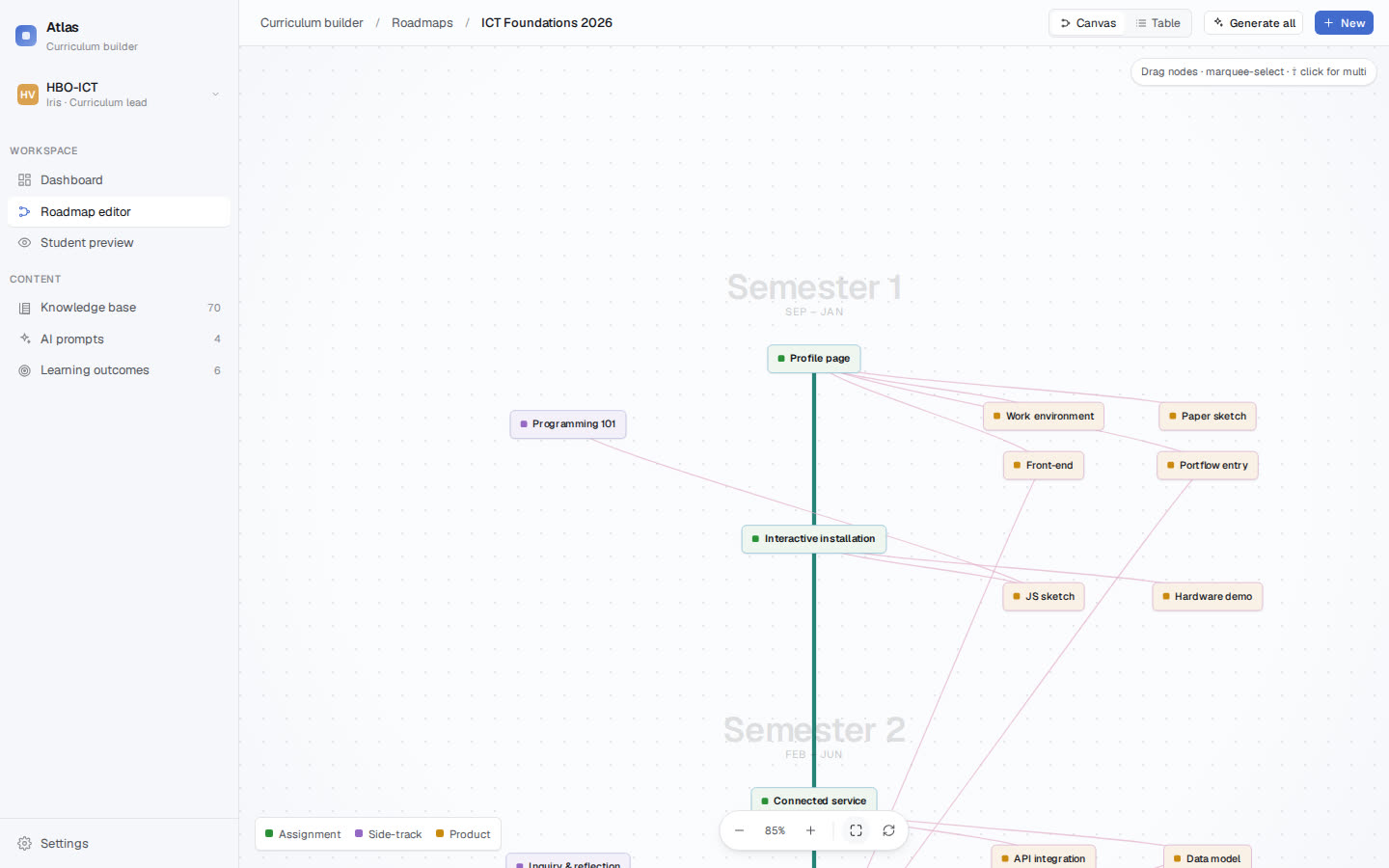
26 May: the picture, a clickable prototype 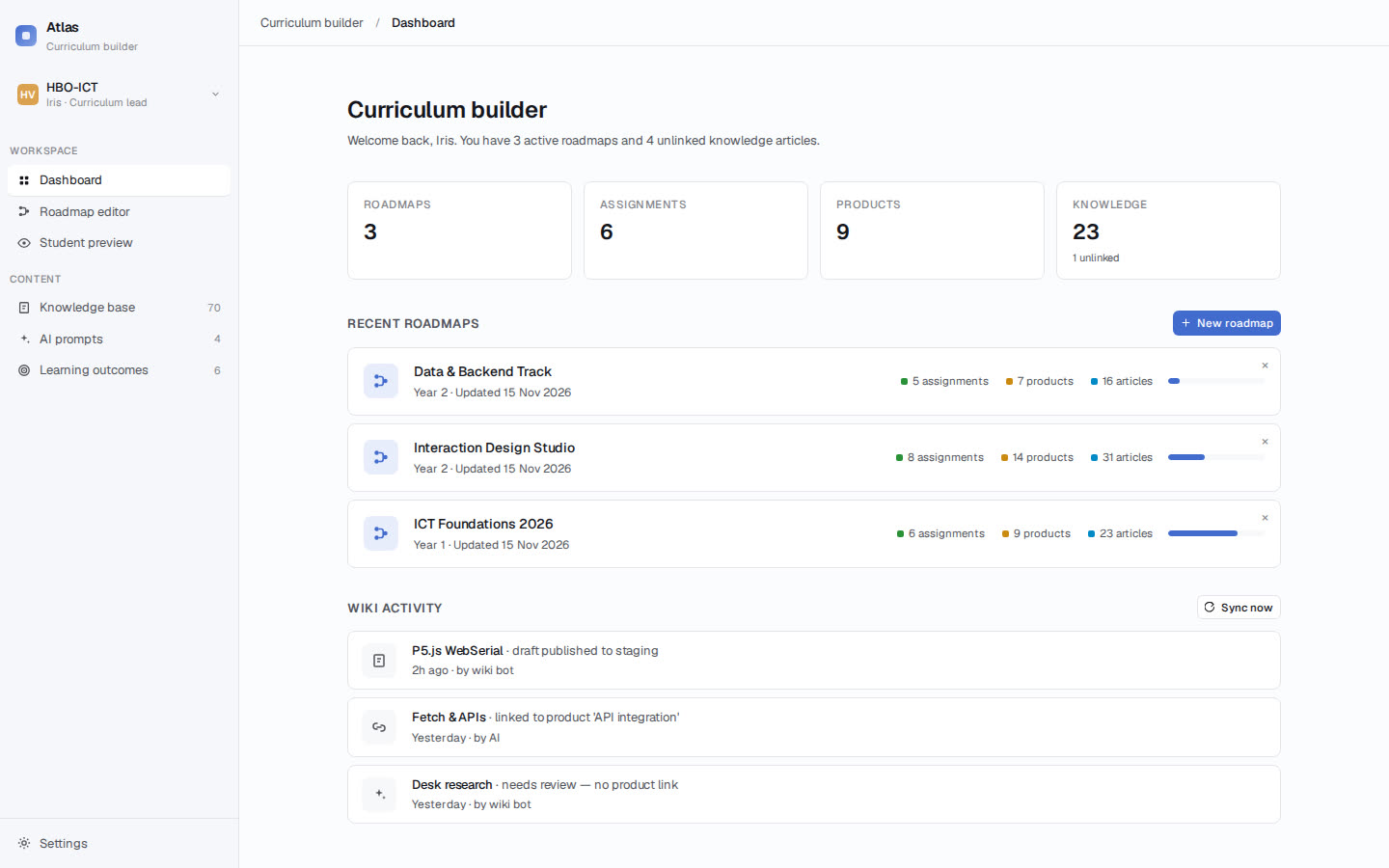
27 May: the same screens, now with a real backend -
27 May
A way of working, agreed on day two
Every feature became a user story on GitLab, a branch and a merge request. The same evening: a SOLID refactor, a broken page caught by Playwright, and tests in CI.
From now on, when I ask for a feature, write a userstory first, pubslish it on gitlab. Open a merge request and a new branch, work on the feature, make multiple intermediate commits and put the MR up for review.
the application is now broken. It seems all styling is removed. Please check with playwright and fix.
Implement unit testing and linting of important cases in the gitlab ci/cd pipeline
-
May – June
The canvas
The roadmap editor grew like a drawing program: marquee select, alignment, connectors that pick their side, labels, containers, tracks, bundled edges and a disperse button.
In the layout-button panel, add a "disperse" button that disperses a group of nodes in an organic fasion, as if they were force directed.
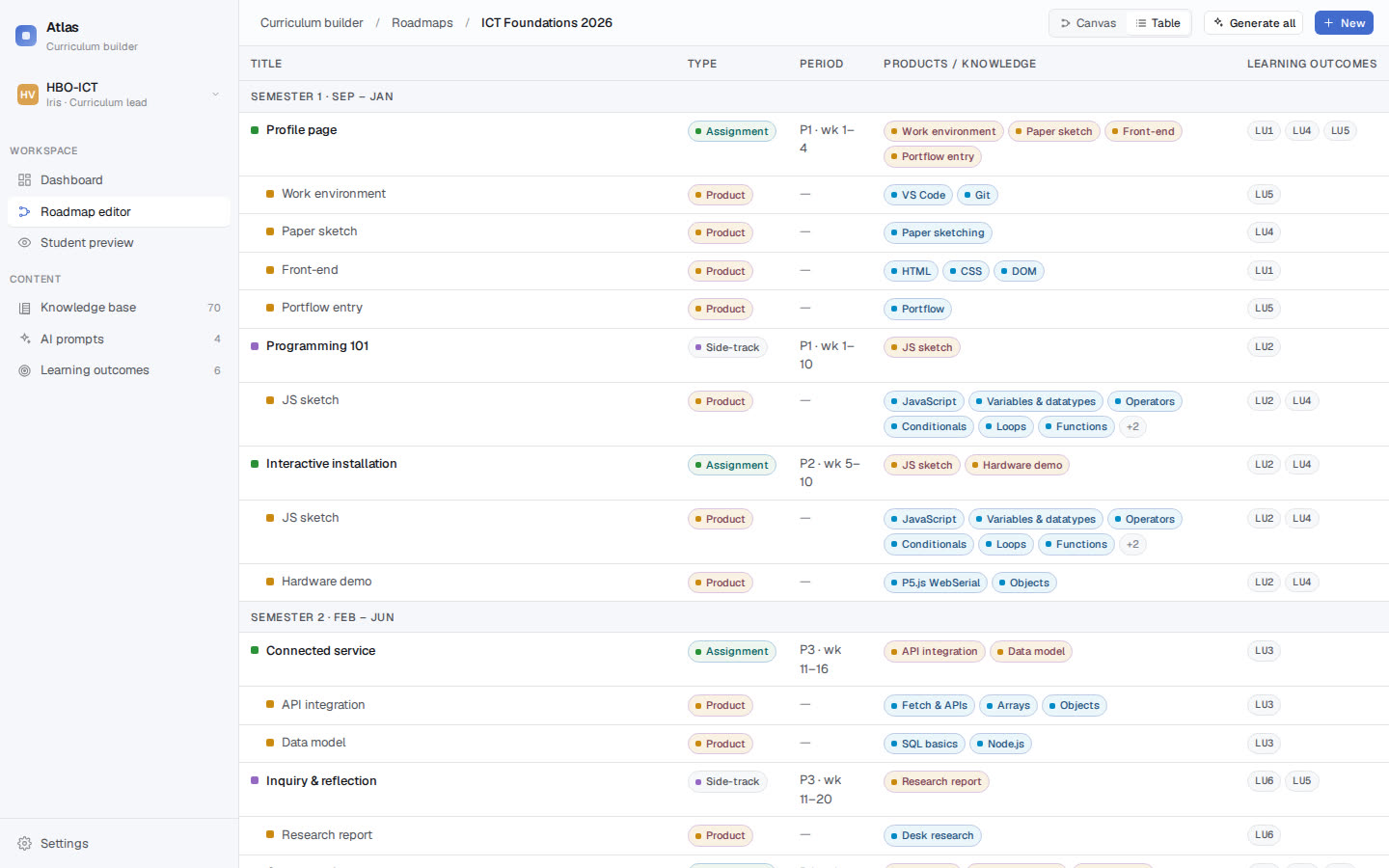
The roadmap as a table, from the prototype onward 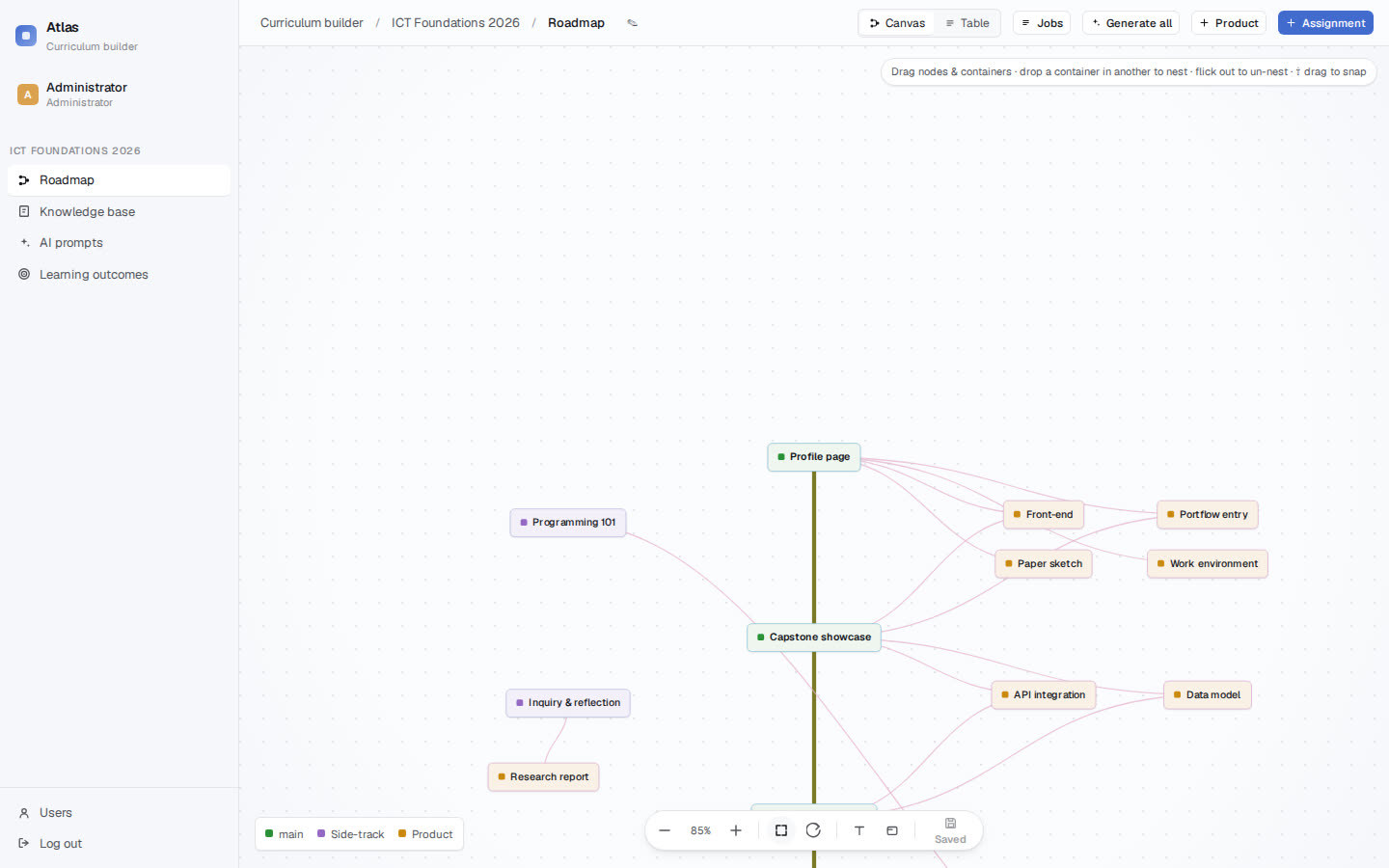
Today: tracks, containers and products on one canvas -
June
WAAS: a wiki that writes itself
The knowledge articles moved into their own service: scrape sources with markitdown, chunk them, let a crew of agents on vonk write the wiki, serve it over an API and MCP. Then the fight against hallucination: grounding, Wikipedia, and a separate validator that runs the code in the articles.
The generated articles should be "grounded" by using the source material and rewriting that into wiki articles. This didn't happen.
In some wiki articles, for instance the mermaid articles, some mermaid code is still "hallucinated" and doesn't work. I think I can prevent this by "closing the loop" and automatically check the generated mermaid code for errors
-
June – September
Publishing for students
Each roadmap gets its own git repository, written with an access token for that one repository, and a CI script that pulls the roadmap renderer and publishes on GitLab Pages. The renderer kept growing: bundles, foldable admonitions, hover labels, a product list, search.
instead of relying on an ssh key I would rather use a gitlab access token so I can only push and pull to a specific repo.
when hovering over a product I want the label to show: "The product <productname> is part of the assignment <assignment>"
-
July
Accounts, and an audit
Authentication with collaborators, built on a branch. Then an audit of the whole codebase, its findings numbered H1 to H11 and fixed one commit each: sanitised Markdown and a CSP, tokens redacted from errors, the job lifecycle under test, services pulled out of the generate router.
I want to create an authentication system in a separate branch. Users can create roadmaps and invite collaborators to edit roadmaps. An admin user can add users to roadmaps. Ask ne questions
-
August – November
In use
Upgrading the running copy on the server without losing its data, repairing hallucinated links, bringing WAAS up to the house standard (tests, CI, accounts), patching dependencies, and in November a search box in every published roadmap.
I want to build a search function into the rendered roadmap. Help me plan this feature.
Tending for quality
Stories, branches, merge requests
From day two, no feature went straight to main: a user story on GitLab first, then a branch and a merge request to review.
Tests and lint in CI
pytest and ruff for the back end, Vitest and eslint for the front end, on every push. Heavy builds run on my own runner.
An audit, worked off by number
Findings H1–H11 plus the medium and low ones, each fixed in its own commit that names the finding.
Closing the loop on hallucination
Grounding in the source material and Wikipedia, a validator service that actually runs the generated code, and a repair pass for invented links.
Look at it like a user
When the styling vanished after a refactor, Playwright opened the page and showed what broke.
Small keys, small blast radius
Each roadmap pushes with a token for its own repository only, and tokens are scrubbed from every error message.